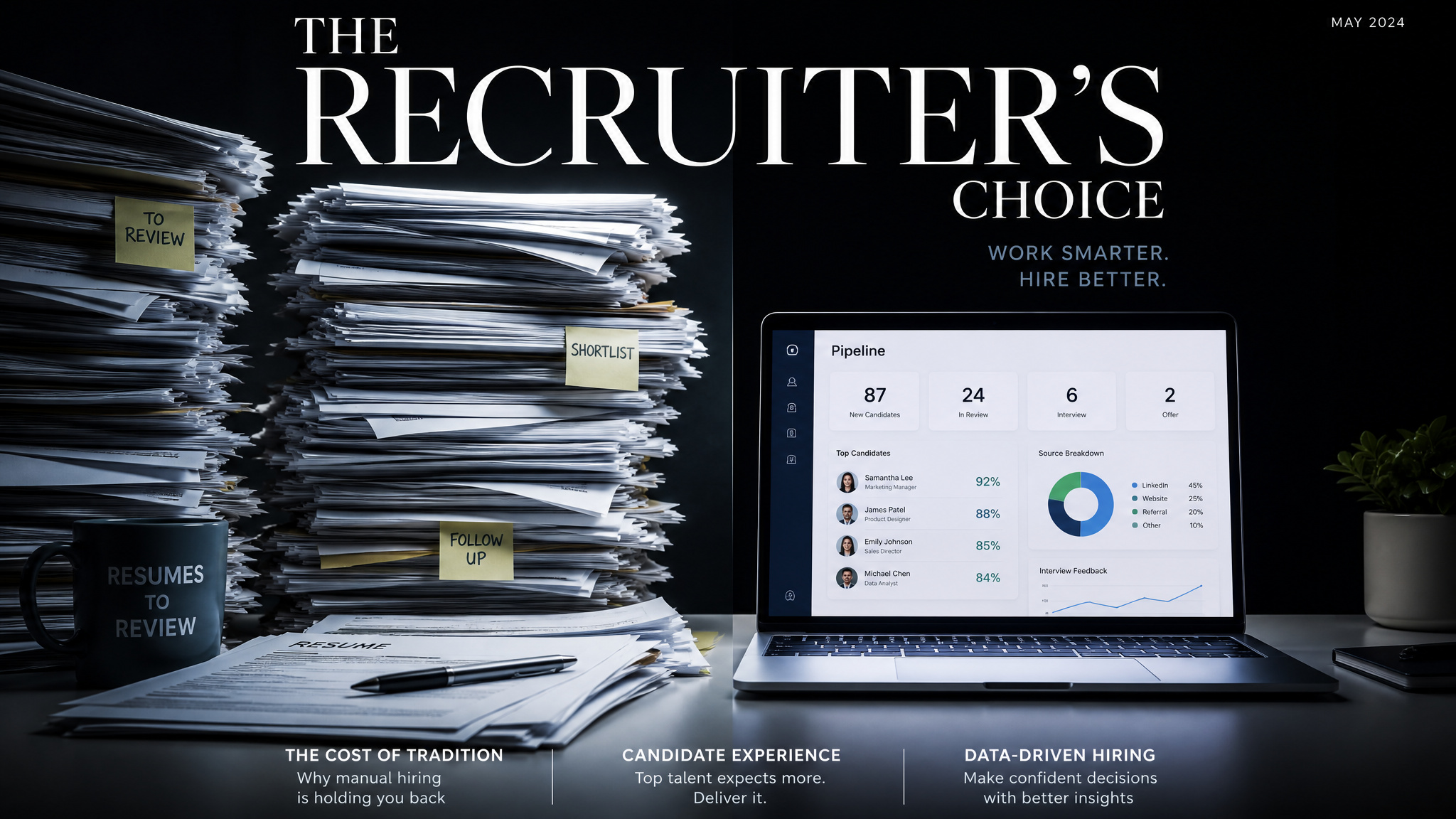
The volume math here is genuinely a little unhinged. Applications per role have climbed 2.7x in ten years, and high-volume roles pull 500 to 1,500+ applicants, and sourcing alone can eat up 30 hours a week of a recruiter’s time. Thirty hours. That’s most of a standard workweek spent on one chore: finding people. Meanwhile talent acquisition teams are handling 40% more requisitions than they were in 2021, and headcount didn’t exactly triple to match.
So the question stopped being “should we use AI in recruiting” a while ago. The question that actually decides whether you get value or burn budget: which kind of AI fits which task? “AI-powered” is a wide bucket: a fixed-rules bot that screens resumes and autonomous agents running entire workflow chains both wear the label, and the price tags scale accordingly. Misclassify your task and you’ll pay agent-tier prices for a scheduling problem a vending machine could solve. That’s the failure mode we want to talk you past. According to Greenhouse’s top AI recruiting software platforms compared,
“AI is most useful when it supports a hiring process that’s already structured, visible and accountable.”
We read vendor spec sheets for a living here, and recruiting AI is the same teardown job as any gadget: strip the marketing label, check the numbers people report, and note where the datasheet gets soft. So here’s the walkthrough: sourcing, screening, scheduling, interviewing, orchestration, buying, and measuring, with real prices and disclosed tradeoffs the whole way down.
Key Takeaways
The best first AI move often costs nothing: Phenom reports that 44% of its 2024 hires
AI screening can cut bias, but only with clean data, stripped identifiers, and real audits; in Mobley v. Workday, plaintiffs allege candidates were rejected within minutes, and a University of Washington study found humans tend to rubber-stamp biased AI decisions rather than fix them.
Scheduling is the highest-leverage automation in the funnel: vendor-reported results include time-to-interview down 40-50% and 2-3x more interviews booked, and it’s a task that genuinely doesn’t need agent-tier AI.
Table of Contents
First, sort your drawer: three classes of AI doing very different jobs
At its simplest, AI recruiting is using artificial intelligence to augment and automate the manual, repetitive parts of hiring, like sourcing, screening, scheduling, and interviewing, while sprinkling in personalization and data insights across the whole process. It’s the tedious stuff gets automated so you can do the interesting stuff. And yes, this is real AI rather than a macro with good PR: automation with intelligence, learning, and reasoning layered on top, not just if-then scripts.
One thing to settle early: this is augmentation, not a robot takeover. A good power tool doesn’t replace the carpenter. More on that later, with actual survey data attached.
But “AI” is not one thing, and treating it as one category is how buying mistakes happen. Think of it as three tools in a drawer:
- General AI. This tier runs predefined tasks under fixed rules and waits for you to trigger it, screening tools, basic chatbots, fit scoring. This is the vending machine of AI: it does one thing, when you press the button. Dismissive as that sounds, it’s often the correct and cheaper answer.
- Generative AI. Prompt-driven content generation, running on LLMs. ChatGPT writing your job descriptions and outreach emails. The talented intern who needs direction.
- Applied AI. The autonomous tier. Context-aware, goal-driven, doesn’t wait for a prompt. Under the hood it combines ontologies (standardized data structures for HR information), reasoning engines, and machine learning to run coordinated workflows across the whole hiring lifecycle. This is the tier that actually watches your pipeline while you sleep.
The one-line version: general AI executes within boundaries, GenAI is a tool you direct, and applied AI watches what is happening, works out what to do next, and carries it out on its own. When you see an “AI-powered recruitment platform” sticker, your first move should be figuring out which drawer the thing actually lives in, and whether the price matches the drawer.
Where AI pays off first: four numbers and a caveat
So what does AI actually buy you? Four clusters of benefit, each with a number attached, and one honest attribution note up front: most of these figures are vendor-reported, meaning the companies who made the spreadsheet are the ones quoting it. Encouraging, hold loosely.

Efficiency. Adopters report 30-50% reductions in time-to-hire. The mechanism is boring and that’s the point: the rote parts get automated, and candidates stop waiting on humans for things humans didn’t need to touch.
Personalization. AI-driven recommendation engines suggest jobs to candidates based on their profile, search behavior, and preferences. That’s not a metaphor, it literally is a recommender system, the same tech family as your streaming queue. Everyone gets a tailored experience instead of a blast email.
Data insights. Your hiring funnel becomes something you can actually read, like a home-lab dashboard. Pipeline health, talent pool dynamics, and rediscovering candidates already sitting in your database, people you paid to acquire and then forgot about. Behavioral signals reveal candidate intent, too: you’re watching what people actually do rather than what they typed.
Bias control. The conditional one. Grading on skills and experience instead of demographic data reduces unconscious bias, and the algorithm doesn’t get nervous or pattern-match on names, if you design it that way. Note the load-bearing phrase. We’ll spend a whole section on the conditions.
There’s also a predictive angle worth flagging: AI can spot strong candidates before an application ever crosses your desk. The pipeline comes to you. Backfilling turns into actual pipeline-building, and when it works that’s honestly the coolest feature in the stack.
Using AI for candidate sourcing and matching
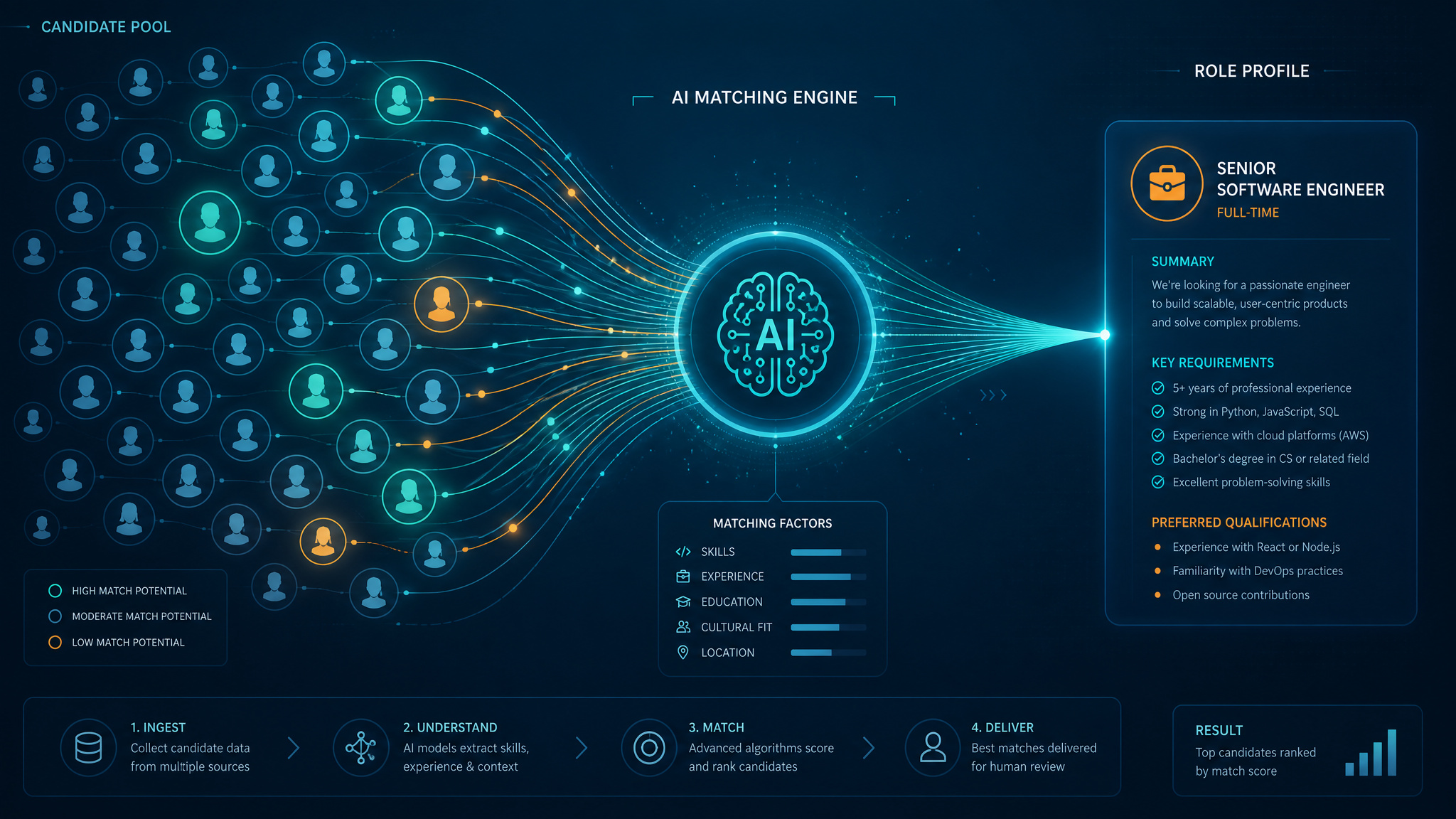
AI sourcing can find qualified candidates dramatically faster and automate the initial screen. Vendor-reported figures say 5x faster sourcing of qualified candidates, teams doubling sourcing capacity without adding headcount, and 30-40% higher response rates when outreach is AI-personalized. (One often-cited claim that sourced candidates are 8x more likely to get hired circulates too, but it arrives truncated in the sources, so treat it as soft until you see the full methodology.)
Start with the people you already paid for
Here’s the counterintuitive centerpiece, and it’s the least covered move in the whole space: talent rediscovery. Most organizations have thousands of past candidates sitting in their ATS and CRM. Silver medalists, past finalists, people who were qualified but the timing was wrong. Your best rejected applicant from last year is in there somewhere.
Per Phenom’s figures, database rediscovery accounted for 44% of hires in 2024, and rediscovered candidates fill roles about 40% faster. The example they give reads like the whole trick in miniature: someone who applied for a Senior Engineer opening 8 months back, reached the final round, and was edged out by a rival with deeper architecture experience, who now slots neatly into a fresh Staff Engineer opening. The system remembered the person you already liked, surfaced them with context, and you skipped the entire top-of-funnel scramble.
Before you buy anything that indexes the public internet, mine what you already have. It costs nothing.
The buyer mistake: judging sourcing engines on database size
The pattern we keep seeing in the spec sheets: teams evaluate sourcing tools on profile counts alone. Bigger number, better tool, right? Not quite.
HireEZ indexes 750M+ profiles from 45+ platforms with AI matching and outreach. Impressive scale. But G2 reviewers report contact-data bounce rates up to 30% on some segments, which is a real tax on any outreach sequence built on top of it. SeekOut goes bigger still, 1B+ profiles including 3.7M+ security-cleared candidates, at roughly $833 per seat per month after a 14-day trial. Powerful, and priced like it.
Neither of those numbers tells you whether the tool fits your bottleneck. Verify before you dial.
Using AI for screening, with the guardrails that actually matter
AI screening can rank candidates and reduce bias, but only under conditions, and this is the riskiest place in the whole funnel to deploy it. Mechanics first: the tool ranks applicants against predefined criteria and grades on skills. The bias reduction only materializes when training data is clean, identifiers like name, age, and gender get stripped from initial screens, and the algorithms are audited regularly. Garbage in, biased garbage out. No exceptions, no magic.

Now the part most vendor pages won’t lead with.
The failure mode: Mobley v. Workday and the rubber-stamp problem
There’s an ongoing case, Mobley v. Workday, where the plaintiff alleges Workday’s algorithmic applicant screening discriminated against candidates on race, age, and disability grounds. One detail does a lot of work here: some rejections allegedly arrived within minutes of applying. Minutes.
That’s how fast the algorithm said no, and it suggests automated screening was acting on employers’ behalf. To be explicit: these are allegations in an unresolved case, not findings of liability. But the shape of the problem is exactly why the oversight section isn’t optional.
And here’s where it gets worse for anyone whose whole strategy is “a human reviews everything.” University of Washington researchers found that human decision-makers often mirrored biased AI decisions rather than correcting them. Rubber-stamping the machine is a documented failure mode, not a hypothetical. Human oversight only works if the human actually overrides sometimes.
So what does real oversight look like? Audit your override rates, because a zero-percent override rate means the human is decorative. Require bias testing from vendors before signing. And follow the Professional Background Screening Association’s checklist: map where you use AI, keep meaningful human review, regularly evaluate your tools for bias and compliance, and be transparent with candidates. Boring checklist, does the job.
Red flag: A zero-percent override rate means your human reviewer is decorative, not supervising. Real oversight includes occasional overrides and vendor-supplied bias testing before you sign.
The surveys say the risk isn’t hypothetical
Resume.org surveyed HR professionals and found 36% had observed AI favoring resumes drafted by the same model it was screening for (yes, AI grading AI’s homework), and 33% had noticed demographic bias patterns. These failure modes have been seen in the wild, not just in papers.
Fraud detection: AI checks AI
One useful sub-use-case: fraud detection. People are increasingly using AI to fake resumes, so AI checks AI. These tools flag a small but real slice of inbound applications, 5-10%, for extra verification, checking resume inconsistencies, degree mills, AI-generated writing style, and work history gaps. The operational rule that matters: flag, never auto-reject. A flag means a second look, not a rejection.
Scheduling and interviewing: the least glamorous features with the best numbers
Yes, AI can schedule interviews fully automatically, and it’s the highest-leverage automation in the entire funnel, because scheduling is where candidates drop off. The problem it solves is real: recruiters spend 5-10 hours a week on three-calendar Tetris across candidates, recruiters, and hiring managers. The mechanics are satisfyingly simple: the system reads calendars, syncs panels and time zones, the candidate picks a slot, the interview books itself. The back-and-forth email thread just dies.

Vendor-reported results: time-to-interview down 40-50%, 2-3x more interviews booked while cutting scheduling effort in half. And here’s the anti-hype part: this is largely a rules-based, self-scheduling problem. It doesn’t need an autonomous agent and you shouldn’t pay agent prices for it. Correct tool, correct drawer.
Interview intelligence: the note-taker that never zones out
For the interviews themselves, the workflow runs end to end. Metaview joins the call, transcribes in 50+ languages, maps answers to your role rubric, and writes a structured scorecard to the ATS when the call ends, with write-back support to 60+ systems. It’s SOC 2 Type II and GDPR compliant, and vendor figures claim 5-10 hours per week of recruiter time saved. Emnify, a customer, reported a 46-point improvement in candidate NPS after the change, which is a vendor-reported number but a striking one: the AI takes the note-taking load off the interviewer’s plate, and the candidate feels the difference.
For high-volume frontline hiring, Puck does something honestly kind of elegant: two-way conversational audio screens delivered via an SMS or email link, about 10 minutes long, no camera, no app. A phone screen that fits in a text thread. For a warehouse or retail candidate on their lunch break, that’s better UX than almost anything fancier.
Candidate-facing AI: the tools that talk to applicants
This cluster is what makes hiring feel less like a form letter. Four pieces of gear.
Chatbots
The front desk that never sleeps. NLP-driven bots handle FAQs, job search help, screening questions, and scheduling, parsing actual candidate questions rather than just keyword matches. Recruiters tune the bot by reviewing conversations and adding responses, like curating a wiki. Scale proof point, vendor-reported: Phenom’s chatbot engaged 20 million candidates over 12 months. Let that number land, then note whose spreadsheet it came from.
Semantic search
The search box that understands what you meant. Semantic search handles intent, context, and word relationships, with the geek-friendly internals being spell correction, synonyms, and prediction. This matters for the same reason it matters on any website: if your search returns junk, candidates bounce. Bad search kills conversion.
Personalization
This one pays twice. For candidates: tailored job recommendations and dynamic career-site content that rearranges itself around your profile and search history. For employees: AI career pathing, learning recommendations, and internal mobility. The system remembers you exist even after you’re hired, which is genuinely neat and criminally underused.
Talent CRM
A CRM, but for candidates instead of sales leads. If you’ve ever used Salesforce, you already understand this, just swap deals for pipelines of people. Dynamic lists, fit and engagement scoring, actionable insights. The point is to find new talent and stay connected to the people you already liked, instead of losing the good ones in a spreadsheet.
Automated first-pass screens also mean the manual phone script doesn’t need a human reading it, and candidates get a fast first impression. Speed is respect.
Now the caveat that stops being a footnote right here: AI performs poorly on messy, siloed data. Teams that buy AI before unifying their data get generic, mediocre outputs and then blame the model. Your model is only as good as your data hygiene. If it can’t show its work on clean inputs, you won’t trust the answer either.
Five GenAI uses you can start this week, and where free tools stop
Can free AI tools like ChatGPT genuinely handle recruiting tasks? Yes, for the prompt-driven ones, and no for the autonomous ones. Here are the five practical ones, mapped against that boundary.
Job descriptions and personalized outreach
The quick win. Drop gendered language like “rockstar,” simplify jargon, add search keywords. Ten minutes of editing, real improvement, and this works without AI too, though AI speeds it up. Same for outreach: nobody answers generic InMails, and tailored messages by skills and experience lift response rates.
Resume screening and matching
Paste in requirements, rank a pile by fit. The stack of 800 resumes gets sorted before your coffee cools. The skills-focused framing can reduce bias, conditionally, with the same caveats as the full screening section.
Chatbots for engagement
Lightweight versions of the bot section above: FAQs, scheduling, pre-screening. The candidate gets answers at 11pm, not next Tuesday.
Predictive analytics
Predicting success, cultural fit, performance potential, upskilling areas. Frame this with honesty: the models are guessing from patterns. Useful guesses sometimes, but not crystal balls.
Cutting time-to-hire by automating handoffs
Here’s the insight worth keeping: the bottleneck was never judgment, it was waiting. Automating the handoffs between people and systems is where the clock time actually goes.
Now the boundary, straight from the taxonomy: free GenAI covers uses 1 and sometimes 3, because those are prompt-driven content and conversation tasks. Anything requiring continuous, autonomous, cross-system execution, like watching a pipeline around the clock or orchestrating workflows across your ATS, CRM, email, and calendar, needs applied AI. No prompt is going to improvise that. Don’t blame ChatGPT for not being an integration layer.
AI agents and orchestration: the full-lifecycle shift
For high-volume and hourly hiring, the answer is conversational automation built for SMS and WhatsApp volume. Paradox’s Olivia handles screening, scheduling, FAQs, and onboarding for frontline workers, built for the hiring volume most dev-blog tools ignore. Pair it with Puck’s audio screens and you’ve got a genuinely functional high-volume stack. At scale, the vendor-reported proof point: Alight made 1,000+ hires in 6 weeks with high-volume automation.
Six weeks. That’s what this tier looks like when it’s pointed at the right problem.
Then there’s the agent picture, which is where things get interesting. Applied AI agents don’t just respond to prompts: they reason, act, anticipate needs, hand off to each other, and escalate to humans when judgment is required. Phenom’s X+ Agents lineup is the fullest public example, spanning eleven stages across the funnel, from intake and sourcing through personalization, voice screening, self-scheduling, interview support, fraud detection, compliance, onboarding, workforce planning, and succession planning. Phenom describes them as zero-configuration agents powered by X+ Ontologies. That’s a vendor claim, but the underlying idea is the genuinely interesting part: ontologies are standardized data structures for enterprise HR data, and if they work as advertised, the agents can reason over a consistent picture of candidates, roles, and outcomes instead of guessing across walled gardens.
Why orchestration beats point automation
Look at the traditional chain: apply, manual screen, CRM entry, email, schedule hunt, review, manual notes. Every arrow in that chain is a place candidates get lost. Point automation fixes individual arrows; orchestration removes them. When CRM, ATS, email, and calendar finally talk to each other without you serving as the middleware, candidates flow through on contextual data, and you handle higher volumes without hiring a hiring army.
The practical takeaway if you’re considering this tier: don’t hand over the whole lifecycle on day one. Pick one stage, usually scheduling or intake, hand it over, watch it, then expand as the evidence accumulates.
Choosing your stack: platform vs point solutions, and the buying trap
The decision hinges on one diagnostic question: do you have one clear bottleneck, or sprawling tooling chaos? And a disclaimer in the interest of spec-decoding honesty: both vendor camps are arguing their own business models here, so treat both as conditional guidance.
First, the anti-hype filter. A lot of vendors marketing “AI hiring tools” are transcription-only products or aren’t really about hiring at all. The genuine categories are four: interview intelligence, sourcing engines, scheduling tools, and conversational AI. If a vendor doesn’t map to one of those, read the datasheet twice.
Then the two paths:
- Platform consolidation. Consolidating 5-10 tools into a single AI-first platform can cut tech spend 30-50%, per Gem and Phenom, because the AI sees the full candidate journey instead of fragments. The pipeline stops leaking at every handoff, and you’re not the middleware anymore. Evidence that consolidation is real momentum in the market: Gem acquired ModernLoop to unify ATS and CRM with native scheduling.
- Point solutions. 2-3 specialized tools targeting your actual bottleneck is often the better fit, especially on constrained budgets. Metaview explicitly positions itself tool-agnostic this way, and the argument is sound: a surgical fix to a diagnosed problem beats a platform suite you’re using a fraction of.
That’s the buying trap, by the way: teams buy an enterprise platform before diagnosing their bottleneck, then use roughly 10% of it. Diagnose first, sign second.
The price spread, for calibration: Manatal starts at $15 per user per month, though it’s thinner on enterprise reporting than Bullhorn or Vincere. Puck starts around $300 a month. SeekOut runs around $833 per seat per month. Enterprise AI hiring platforms are quote-based, typically $25K to $250K+ per year.
There’s an entry point at almost every budget, and the spread is wild. Know which problem you’re solving before the six-figure conversation.
Measure first, then implement without breaking things
The prerequisite comes before any purchase: write down five baseline numbers, time-to-hire, cost-per-hire, source effectiveness, response rates, and recruiter capacity. No baseline, no proof the AI did anything. You’ll be stuck arguing with vibes, and the vendor’s numbers will always sound better than yours because they made the spreadsheet.
On integration, prefer native bidirectional ATS and HRIS connections over glue-and-hope middleware. If the data can’t flow both ways, your shiny AI is reading a stale copy.
Implementation itself is the boring checklist that decides whether this works: define goals, integrate with existing HR systems, keep human oversight, monitor and refine the models, and train the recruiters. None of it is glamorous. All of it is load-bearing.
For team buy-in: show, don’t memo. Live demos, feedback loops, internal champions. If you want the deeper change-management angle, NTT has published useful research on HR tech adoption, and QuantumWork’s material on the same topic is worth a read. And the people doing this aren’t passive about it: Workday research finds over 90% of HR professionals say they play a role in AI implementation at their organizations.
This isn’t being done to HR; HR is driving it. Workday’s AI Indicator Report adds that 40% of HR leaders say AI helps teams deliver more strategic value, rising to 54% among AI pioneers, the people actually using it report more value than the observers. And over 80% of executives believe AI will make human skills more vital, not less. Even the C-suite thinks the humans stay essential.
The recruiter’s role, and the confidence gap nobody talks about
AI augments recruiters, full stop. It’s an assistant and advisor, and humans keep the judgment calls that need empathy, culture reads, and final decisions. The job itself moves: less backfilling after the fact, more strategic hiring before the req opens, and quality-of-hire metrics finally give recruiters and hiring managers the same dashboard to argue from. The human parts get more hours, not fewer.
As BambooHR’s Nicole Csizar put it,
“The more we use AI in recruiting, the more human the interview can become.”
The quote is doing real work: AI can take prep, notes, and organization off the interviewer’s plate, which is exactly the stuff that distracts from being present with the person in front of you.
Now the tension, because it’s the most interesting data point in the whole article. BambooHR surveyed 500+ HR professionals and found 67% would trust AI to conduct an interview entirely on its own, and 92% are piloting or planning AI agents. Meanwhile, Resume.org found 36% of HR pros observed AI favoring resumes drafted by the same model, and 33% saw demographic bias patterns. Both things are true at once: HR is more confident in AI than the observed failure modes warrant.
That 67% figure deserves a raised eyebrow precisely because section five established that unwatched screening produces minutes-fast rejections and rubber-stamped bias. Confidence without override-rate audits is exactly how automation bias takes root. Trust the tool after you’ve measured it, not before.
Quick answers
The short version of everything above, distilled into the questions we hear most often. Each answer sticks to what the article actually covered, with the caveats and conditions intact, because the caveats are the load-bearing parts.
What is the 30% rule in AI recruiting?
Honestly? It’s ambiguous, and anyone giving you one clean definition is manufacturing it. There are two sourced interpretations floating around: a 30/70 split where AI handles roughly 30% of recruiting tasks and humans handle 70%, and a benchmark claim of around 30% improvements across hiring KPIs. Both circulate.
Neither has settled into a standard. If someone quotes “the 30% rule” at you, ask which one they mean.
Can recruiters tell if you used AI on your application?
Partially, yes. Detection tools look at AI-generated writing style, scripted-answer patterns, response timing and consistency, and identity checks across your materials. Operationally, the sane approach on the recruiter side is flag-and-verify: AI flags 5-10% of applications for a second look, and no one gets auto-rejected by a detector. Same mechanism as the fraud detection section, same rule: flags mean verification, not verdicts.
What’s the compliance quick check before deploying AI hiring tools?
The Professional Background Screening Association’s four actions: map where you use AI, keep meaningful human review in the loop, regularly evaluate your tools for bias and compliance, and be transparent with candidates. Regulation context to track: the EU AI Act and GDPR, both of which touch automated hiring decisions. Kara Dennison at Resume.org offers a transparency standard worth adopting: explain where AI is used, whether it recommends or rejects, how much human oversight exists, and what data is collected. Here’s the framing that makes this land for skeptics: documented, transparent AI decisions are defensible decisions. It’s the cheapest legal insurance in the stack, and it doubles as a recruiting feature for candidates who care about being treated fairly.
Where to start
Start where it’s free: Phenom’s research put database-sourced hires at 44% of its 2024 total, so a rediscovery pass on your own ATS needs no purchase and no vendor pitch. From there, the ledger is short. The wins: efficiency, personalization, bias control, and data-driven decisions. The risks: dirty data, team buy-in, and a system that will happily learn bias from you. The tool landscape spans recommendations, content generation, intelligent search, chatbots, fit scoring, interview assistants, insights, candidate discovery, and agents, a shopping list, not a hierarchy.
The sequence, which is the part to actually keep: measure your baseline numbers, clean up your data, run a rediscovery pass on the database you already have, then buy one point tool matched to your diagnosed bottleneck, and expand toward orchestration only as the evidence accumulates. Cheap steps first, reversible steps first, proof before scale.
And the closing beat, which is also the honest answer to “will this replace recruiters”: no. AI handles the repetitive. Humans handle the human.
Frequently Asked Questions
How do I use AI in recruitment?
Start free: run a rediscovery pass on candidates already sitting in your ATS, since database-sourced hires accounted for 44% of Phenom’s 2024 hires and fill roles about 40% faster. Then use AI for sourcing, screening, scheduling, and interview note-taking, keeping human oversight with audited override rates. The sequence that works: measure baseline numbers, clean your data, buy one point tool matched to your diagnosed bottleneck, and expand only as evidence accumulates.